Safe Spaces is a participation and communication platform that helps autistic and neurodivergent people prepare, share what helps and communicate before, during and after an experience. Choose the route that is right for you.
Participation is shaped by the interaction between the person, the professional, the environment, the activity and the organisation.
Safe Spaces focuses on better preparation, clearer communication and practical adjustments. The person is not left to overcome barriers or repeat the same information on their own.
For individuals, families and supporters
Your information. Your pace. Your voice.
Safe Spaces gives you a clearer way to prepare, share what helps and communicate when finding the words is difficult. Use it for yourself or alongside someone you trust, with your voice and choices kept at the centre.
Know more about a place, appointment, session or meeting before you arrive.
Add what helps generally and what matters for a particular booking, with relevant information sent to the right people.
Use Green, Amber or Red with words and shapes; Red never needs an explanation.
Keep follow-up clear so you know what happened and what comes next.
Welcome back. Take your time. Start wherever feels most useful.
Nothing needs to be completed all at once.
Coming upYour next bookingView all bookings
Inside Safe Spaces
See the connected experience in action.
A closer look at the screens people and authorised teams use to prepare, share, communicate and follow up in one connected journey.
For individuals
Prepare before you arrive
Bring the place, people and plan together before an experience begins.
SafeSpacesSafe SpacesMy plan
Before you go
Your visit plan
Ready
Everything in one placeOpen each part when you feel ready.
About the placeEntrance, layout and quieter spaces
Who you will meetRoles, introductions and who can help
What will happenA clear step-by-step plan
For individuals
Choose what helps
Keep useful preferences together and decide what is shared each time.
SafeSpacesSafe SpacesMy profile
What helps me
My access preferences
Choose the things that can help remove barriers for you.
A quieter place to waitEnvironmentChosen
More time to processCommunicationChosen
Written informationInformation formatChosen
You stay in controlReview what is shared for each experience.
For individuals
Communicate in the moment
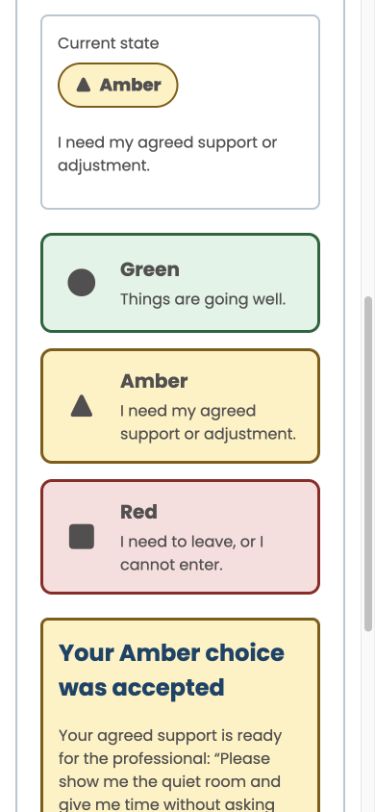
Use a clear word and shape when speaking is difficult.
SafeSpacesSafe SpacesCommunication
Communication available
Current stateNo EventNo choice has been accepted yet. This is not Green.
GreenThings are going well.
AmberI need my agreed support or adjustment.
RedI need to leave, or I cannot enter.
Red does not need an explanation.
For individuals
Know what happens next
Follow an update from acceptance through to a completed response.
SafeSpacesSafe SpacesMessages
Response status
Your communication update
Amber communicationYour update is moving through the response pathway.
You can see each stage without having to ask for progress.
AcceptedYour choice was recorded.
DeliveredThe authorised team received it.
AcknowledgedThe team has seen your update.
Response completeThe agreed response is recorded.
For authorised teams
Coordinate the response
Give the right team a clear, accountable sequence from receipt to completion.
SafeSpacesSafe SpacesTeam workspace
Live response
Communication received
Authorised view
Current communicationAmber
Agreed support or adjustment requested.
AcceptedRecorded by Safe Spaces
DeliveredShown to this team
AcknowledgeConfirm the update has been seen
Complete responseRecord the agreed action
Only the minimum information needed for this response is shown.
For organisations
Improve services and spaces
Bring together feedback people choose to share and see where barriers can be reduced.
SafeSpacesSafe SpacesService insights
Access overview
Where to focus
Review themes across the whole experience without losing the person’s voice.
01Preparation informationPlaces, people and plans
02Environment and accessSpaces, routines and adjustments
03Communication and responseClarity, consistency and follow-up
One connected journey
Preparation starts before the experience does
Clear information before arrival, live communication and thoughtful follow-up can reduce uncertainty across the whole journey.
01
Before
Arrive with fewer unknowns
See where you are going, who you will meet and what is likely to happen. Share what helps, in your own time.
02
During
Communicate in the moment
Use clear Green, Amber and Red choices. Words and shapes also help when speaking may be difficult.
03
After
Make the next time better
See what happens next, reflect on what worked and help the next experience feel more prepared.
For organisations and businesses
Turn individual insight into prepared, consistent action.
Safe Spaces connects the information, communication and follow-up that often sit in different places. Teams can prepare earlier, respond clearly and improve the experience without asking people to explain everything again.
Prepare before arrival
Give people clear information about places, people, routines and what to expect, in formats that work for them.
Share what helps
Let each person record what helps, with relevant information shared only with authorised people for that experience.
Communicate in the moment
Offer clear Green, Amber and Red choices using words and shapes, while showing whether the communication pathway is available.
Coordinate the response
Help authorised teams receive, acknowledge and complete agreed responses with a clear status at every step.
Connect the whole journey
Bring preparation, participation and follow-up together without asking the person to repeat everything each time.
Improve services and spaces
Use structured feedback people choose to share to identify barriers and improve environments and ways of working.
Trust beneath the surface
Clear foundations. Human accountability.
Safe Spaces is built around clear requirements, evidence-informed design and careful permissions. People can see what has happened, what is still waiting and what the technology can and cannot do.
Technology supports the relationship.It never replaces the person, the professional or a required human decision.
Clear foundations
Product decisions draw on clear requirements, evidence and lived experience.
Protected by design
Only relevant, authorised information is shared, and service status is shown honestly.
Human accountability
Sensitive decisions and required reviews stay with accountable people.
Across different settings
One approach. Shaped around each organisation.
The same connected journey supports different people, services and environments. Each organisation applies it through its own language, roles and responsibilities.
01
Students · staff · campuses
Universities & education
Support campus orientation, teaching, appointments, transitions, placements, events and agreed adjustments.
02
Patients · carers · teams
NHS & healthcare
Support appointment preparation, clear communication and agreed reasonable adjustments with separate NHS hosting and governance.
03
Employees · managers · visitors
Workplaces & business
Create clearer onboarding, meetings, routines, environments, events and day-to-day support at work.
04
Participants · staff · venues
Sport, leisure & community
Reduce barriers across sessions, bookings, venues and live communication.
Every use starts with the person and is configured around the organisation’s roles, responsibilities, evidence and boundaries.
For people and partners
Questions from individuals and organisations
Whether you are considering Safe Spaces for yourself, someone you support or a whole organisation, the person remains at the centre.
What can Safe Spaces help me do?
Safe Spaces can help you understand what to expect, keep useful information in one place, share what helps on your terms and communicate before, during and after an experience. You can use it for yourself or involve someone you trust.
Do I stay in control of my information?
Safe Spaces is designed around your choices. You decide what information to add to your profile and each booking. Professionals see only the relevant information they are authorised to use for that booking and their responsibilities.
What does Safe Spaces do for organisations?
Safe Spaces connects preparation, personal preferences and agreed adjustments, in-the-moment communication, staff response and follow-up in one clear journey. It helps teams prepare earlier, respond consistently and see where environments or processes can improve.
Is Safe Spaces only for sport?
No. Safe Spaces began with sport and activity, and its core preparation and communication approach can also be shaped for universities, NHS trusts, workplaces and community organisations.
Does the traffic-light system rely on colour?
No. Green, Amber and Red are supported by clear words and distinct shapes. A person’s choice is also kept separate from whether the communication pathway is actually available.
How can Safe Spaces fit our organisation?
Safe Spaces can support one focused journey or connect several touchpoints across an organisation. Roles, permissions, information sharing and integrations are shaped around each setting. NHS use follows separate hosting and governance arrangements.
SafeSpacesSafe Spaces
One platform · Two ways in
Start with the route that is right for you.
Explore Safe Spaces for yourself or someone you support, or see how it helps organisations prepare and respond. We are also in conversation with universities, NHS trusts, businesses, sport providers and community organisations.